








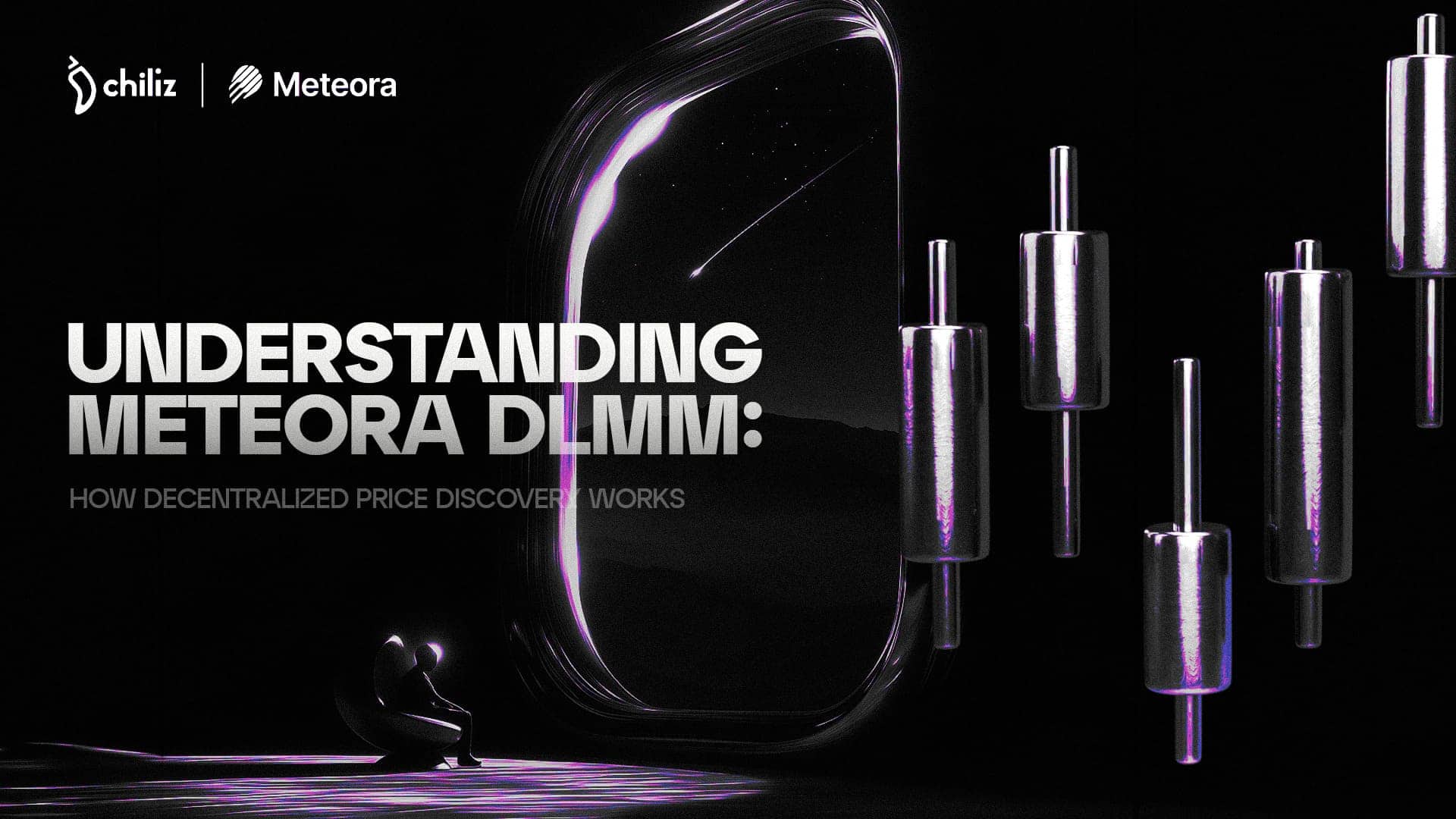
Meteora is a decentralized liquidity protocol built on Solana. It allows tokens to be traded without requiring a centralized exchange to pair buyers with sellers.
This arrangement offers a number of advantages, not least in that it’s entirely non-custodial. Your tokens stay in your wallet, in other words, until the point at which you choose to swap them for a different digital asset.
But Meteora offers much more than non-custodial trading. It’s also designed to be a liquidity hub, serving as a universal portal where tokens can be traded with minimal slippage and where price discovery can occur. Its Dynamic Liquidity Market Maker (DLMM) provides a flexible way for a market to discover the fair price of an asset – an attribute that could prove particularly useful in the context of Fan Tokens.
Let’s break down how it works.
What is Meteora?
Meteora provides infrastructure that allows digital assets – i.e. tokens – to be exchanged without requiring a central exchange to serve as broker and custodian. Instead, assets can be traded directly through interacting with smart contracts.
Meteora offers several different types of liquidity pools, with its most popular being the DLMM. This is a sophisticated type of automated market maker (AMM). Traditional AMMs generally distribute liquidity continuously along a mathematical price curve, but Meteora’s DLMM divides liquidity into individual price ranges known as bins.
That’s the official name for them, but a better way to visualize them is as rungs on a ladder, with each rung representing a slightly different token price. For example, a SportFi token trading against USDC might be placed on rungs representing prices such as $0.98, $0.99, $1.00, $1.01, and $1.02.
With Meteora’s DLMM, liquidity can be placed into different bins rather than being spread uniformly across every possible price.
At any given moment in time, trading takes place around an active bin representing the current market price. If buying pressure consumes all of the available tokens at that price, trading can move into the next bin at a higher price, while if selling pressure pushes in the opposite direction, it will move towards lower-priced bins.
Think up or down the ladder.
One of the neat things about Meteora’s architecture is that trades completed entirely within a single bin occur at the same exchange rate, resulting in zero price impact within that bin. Larger trades, however, may consume liquidity from multiple bins and therefore move across different prices.
What is decentralized price discovery?
This brings us to price discovery, the process through which a market determines the price at which people are willing to buy and sell an asset. On a centralized exchange, makers provide liquidity by placing buy or sell orders in the order book, while takers execute trades by accepting these existing orders at their set prices.
Decentralized exchanges such as Meteora do a few things differently. Firstly, they have no central custodian to accept customer deposits – instead, assets remain in the user’s wallet until the point at which they are traded for a different digital asset.
Secondly, with decentralized exchanges that don’t use an orderbook like the centralized model described above, price discovery occurs organically. It’s based on the actions of hundreds or thousands of buyers and sellers.
To illustrate, imagine a new token that starts trading at $1 on Meteora. If demand is strong, buyers begin acquiring the asset and as available liquidity at $1 is consumed, trades progress into higher-priced bins. If more token holders decide to sell, conversely, the process moves in the opposite direction, moving the token towards lower-priced liquidity.
This is decentralized price discovery in action, whereby the interaction between traders and available onchain liquidity helps establish the market price. This model has interesting implications for fan tokens, incidentally, since an aspiring sports club could use DLMM infrastructure to create an onchain market in which price discovery occurs through trading activity.
Rather than thinking of a launch as simply assigning a token a price, it is more useful to think of it as creating the conditions in which a market can discover a price. Which applies whether the asset in question is a Fan Token®, memecoin, or protocol token.
What Meteora does differently
If you’ve experience of trading on DEXs, you might be wondering why Meteora has favored a different version of the AMM model that’s popularised on other chains such as Ethereum. Basically, because Meteora’s engineers believe that bins give liquidity providers more control over where their capital is available.
With older AMM designs, liquidity is spread across a broad range of possible prices, resulting in significant capital sitting far away from the current market price and rarely being used. More recent AMM designs such as Uniswap V3 have tried to atone for this, while Meteora’s DLMM model forms an elegant solution that also allows liquidity to be concentrated within particular ranges.
Concentrating liquidity around prices where trading is expected to occur improves capital efficiency, while liquidity providers can distribute liquidity differently across bins depending on their objectives. Meteora supports different liquidity shapes and ranges rather than forcing every provider to distribute capital in exactly the same way.
Dynamic by design
There’s a final novel feature of Meteora’s DLMM that we’ve yet to touch upon: it supports dynamic fees. This allows trading fees to adjust in response to market conditions including volatility. During periods of greater volatility, the dynamic component of the trading fee can increase, while in calmer conditions it can fall.
This is particularly useful when a new asset first becomes tradable. With little or no trading history to guide price discovery, newly launched tokens often experience significant volatility as the market works out what they’re worth. This can expose liquidity providers to greater impermanent loss, but DLMM’s dynamic fees help offset this risk by allowing LPs to earn higher trading fees during periods of heightened volatility.
Meteora’s DLMM launch pools can support single-sided liquidity, meaning a pool can initially be created using the new token without requiring an equivalent amount of SOL or USDC to be deposited alongside it. As trading begins, buyers and sellers then interact with that liquidity and the market starts producing its own price information.
Simple once you know how
DLMMs may sound complicated because terms such as liquidity bins, AMMs and dynamic fees describe tech that most people never encounter in traditional financial markets. The underlying concept, however, is much simpler.
A market needs assets available for people to trade, a mechanism for executing those trades, and a way for supply and demand to translate into a changing price. Meteora’s DLMM provides all three through smart contracts on Solana.
In the next educational guide in this series, we’ll look more closely at what happens inside a DLMM pool and what you should understand before interacting with one.