







Blockchains started as single, all-in-one systems. It can be likened to a busy kitchen where one chef handles cooking, washing dishes, taking orders, and managing payments. This setup works for small restaurants, but it struggles when crowds grow large. Every task competes for the same attention, leading to slow service, high costs, and difficulty fixing or improving just one part.
However, modular blockchain architecture changes this approach. Instead of one big system doing everything, it splits the work into separate specialized pieces. These pieces include, execution, settlement, consensus and data availability.
These pieces, although function independently, are still connected to one another. Think of it as a team of experts: a fast cook for meals, a reliable waiter for orders, a secure accountant for payments, and a strong manager for final decisions. Each can improve or swap out without rebuilding the whole kitchen. So how can modular blockchain architecture help to optimize tasks for flexibility, upgradability, and resilience? This post provides a detailed answer.
The Blockchain Developer Ecosystem
A blockchain system relies on several core components that work together to create a secure, decentralized network. These include:
- Consensus mechanisms: The rules that let network participants (nodes) agree on the order and validity of transactions. Common examples are Proof of Work (used in Bitcoin) and Proof of Stake (used in Ethereum after its upgrade).
- Smart contracts: Self-executing code stored on the blockchain that automatically runs when conditions are met, enabling programmable applications like automated payments or token transfers.
- Wallets: Tools that let users store private keys, sign transactions, and interact with the blockchain.
- Block explorers: Public tools (like Etherscan for Ethereum) that allow anyone to view transactions, blocks, wallet balances, and network activity in real time.
- Nodes: Computers running the blockchain software that validate transactions, store the ledger copy, and help maintain the network.
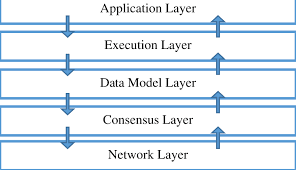
Other supporting pieces include oracles (for bringing real-world data on-chain) and bridges (for moving assets between chains). In modular architectures, these components often split across specialized layers (execution, consensus, data availability, settlement), giving developers more choices than in single-unit (monolithic) designs.
Source: ResearchGate
Similarly, developer experience (often called DevEx or DX) plays a central role in blockchain growth. When tools, documentation, and workflows feel familiar and efficient, more developers join, build applications, and experiment. This leads to faster innovation and broader use of the technology. Poor experience, by contrast, slows progress and limits projects.
However, blockchain developers face distinct challenges compared to traditional software development:
- Immutability: Once deployed, code cannot be easily changed or patched. Bugs become permanent unless planned workarounds exist, raising the cost of errors.
- Decentralized and hostile environment: Code runs across untrusted nodes with no central control. Developers must account for potential attacks, like malicious actors or network forks.
- Security demands: Financial value often flows through applications, so even small vulnerabilities can lead to major losses. Auditing and testing take more time and expertise.
- Scalability and performance limits: Networks process transactions slower and cost more during high demand than centralized servers. Developers optimize gas usage or choose Layer 2 solutions.
Blockchain Development Tooling
Blockchain developers rely on specialized IDEs, frameworks, and libraries to build, test, deploy, and interact with smart contracts and dApps. These tools vary by blockchain due to different languages and architectures.
Here are some of the most widely used ones (focused on Ethereum and EVM-compatible chains, as of 2026:
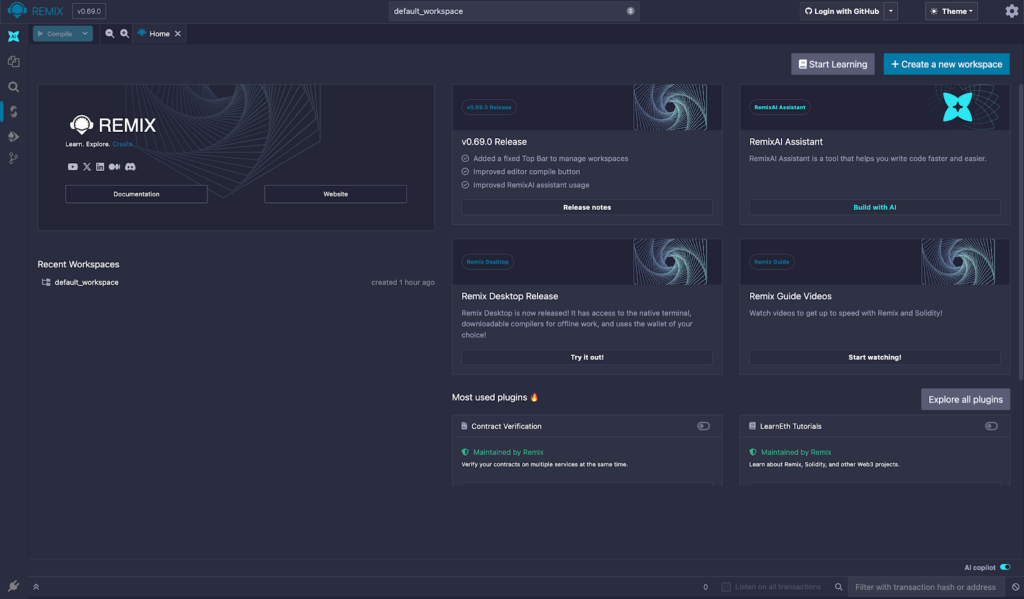
- Remix IDE A browser-based editor for Solidity smart contracts. It allows quick writing, compiling, debugging, and deployment without any installation. Ideal for beginners and fast prototyping.
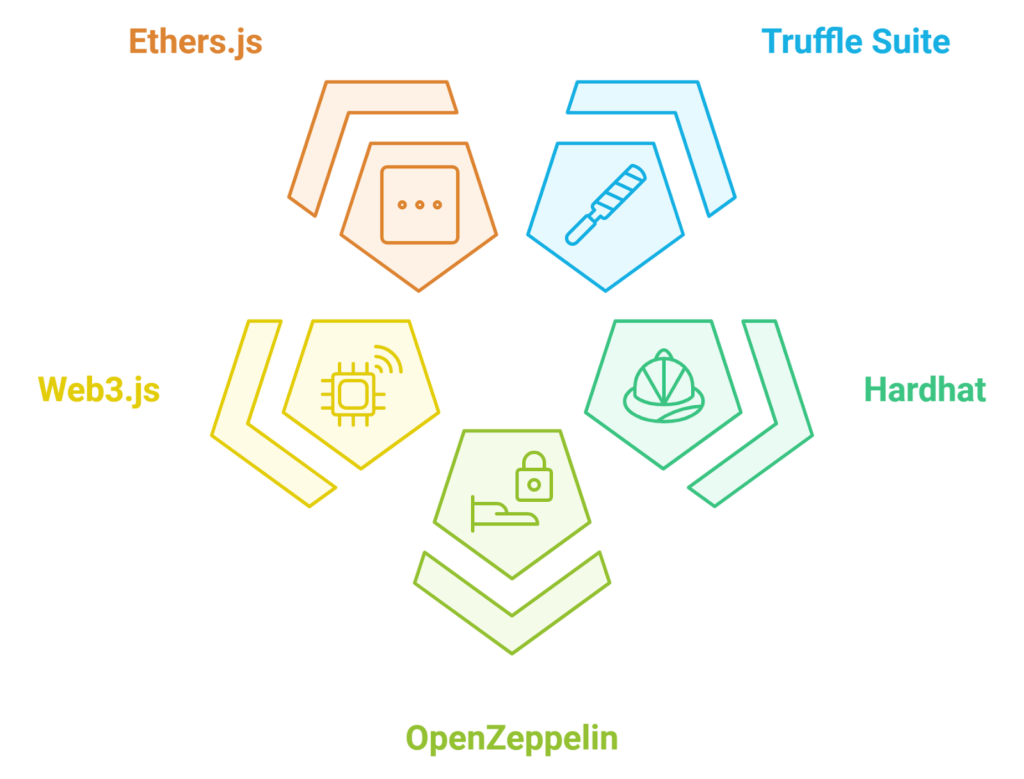
- Hardhat: A flexible JavaScript/TypeScript development environment for compiling, testing, debugging, and deploying smart contracts. It includes a local blockchain network, extensive plugins, and strong integration with front-end workflows. Popular for team projects and complex dApps.
- Foundry: A fast, rust-based toolkit for solidity development. It offers rapid compilation, built-in testing (in Solidity), fuzzing, and tracing. Many developers prefer it for performance and security-focused testing in 2026.
- Truffle (Truffle Suite): An older but still-used framework with tools for compiling, testing, and deploying contracts, plus Ganache (a personal blockchain for local testing).
- OpenZeppelin: A library of secure, audited, reusable smart contract components (e.g., ERC20 tokens, access control, upgrades). Developers import these to avoid common vulnerabilities and speed up building.
- Ethers.js: A modern, lightweight JavaScript library for interacting with Ethereum nodes—signing transactions, reading data, and calling contracts. It offers clean APIs and strong TypeScript support.
- Web3.js: The classic JavaScript library for blockchain interaction. It remains in use for legacy projects but Ethers.js has largely taken over due to better design and maintenance.
Tools across other networks:
- Solana (Rust-based): Anchor framework dominates for writing secure programs with macros, auto-IDL generation, and easy testing. Native Rust tools handle lower-level work; Solana CLI supports setup and deployment.
- Polkadot (Substrate/Rust-based): Ink! for smart contracts or FRAME pallets for runtime modules. Tools focus on parachain customization and cross-chain features.
Emerging trends in 2026:
- No-code/low-code solutions: Platforms let non-coders build dApps via drag-and-drop or templates, speeding prototyping (e.g., for simple tokens or workflows).
- Multi-chain compatibility: Tools support EVM + non-EVM (Solana, Polkadot) with unified interfaces, bridges, and cross-chain testing.
- Advanced testing suites: Built-in fuzzing, formal verification, and AI-assisted debugging improve security in high-value environments.
Modular architectures benefit from these trends by letting developers mix tools per layer.
Smart Contract Architecture and Design Patterns
Smart contracts are self-running code on blockchains that handle rules and agreements without intermediaries. Building them requires focus on security and scalability.
Principles of Secure and Scalable Smart Contract Development
- Keep code simple and minimal: complex logic creates more chances for mistakes.
- Follow patterns like Checks-Effects-Interactions (CEI): check conditions first, update state next, then interact externally.
- Use audited libraries (e.g., OpenZeppelin) instead of writing common functions from scratch.
- Plan for immutability: code cannot change after deployment, so design with upgrades in mind and test thoroughly.
Common Design Patterns and Their Use Cases
- Factory pattern: A contract creates multiple instances of other contracts (e.g., deploying many token or game contracts from one place).
Use case: Efficiently create user-specific contracts without manual deployment each time.
Cloning Solidity smart contracts using the factory pattern
- Proxy pattern (upgradeable) — Separates storage (state) from logic. A proxy contract holds data and forwards calls to a changeable implementation contract.
Use case: Fix bugs or add features without losing existing data or changing the contract address. Common variants include Transparent Proxy, UUPS, and Beacon.
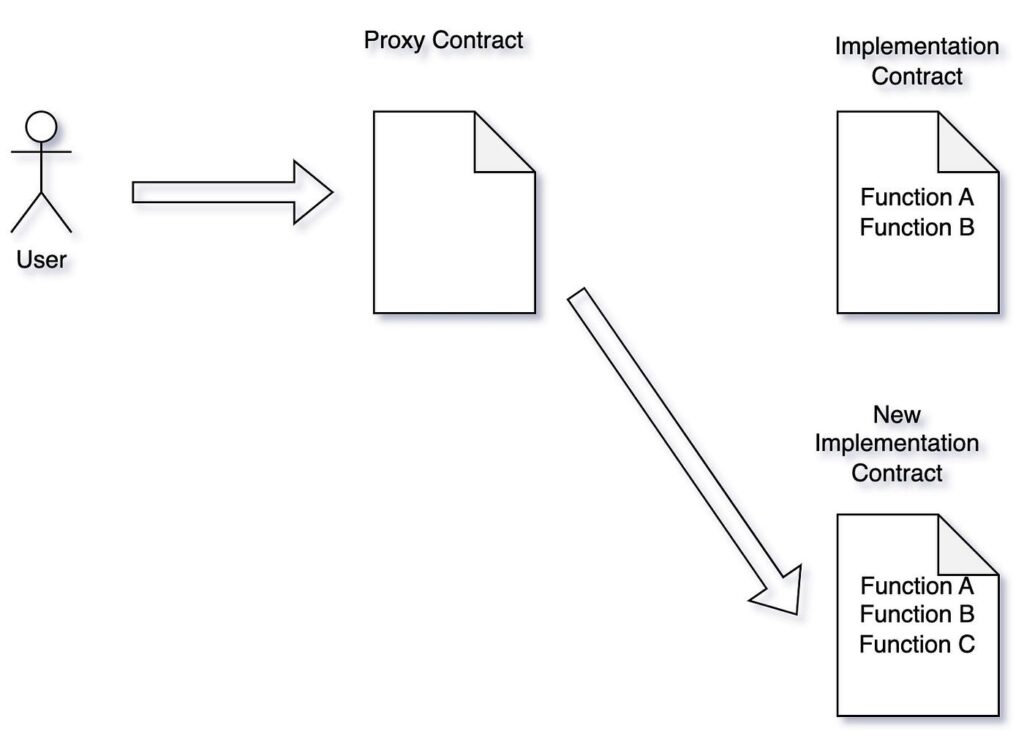
Proxy Pattern Upgraded Graph
For Upgradeable Smart Contracts
Approaches to Managing State, Handling Failures, and Ensuring Data Integrity
- State management — Use mappings or arrays carefully.Avoid storage collisions in proxies by following strict layout rules (e.g., append new variables only).
- Failure handling — Implement try-catch for external calls; design pausable contracts to stop operations if needed.
- Data integrity — Rely on blockchain’s immutability for on-chain data; use oracles or multiple sources for off-chain info
These patterns and practices help create contracts that last longer and handle real-world demands better. Modular designs build on them by separating concerns across layers.
Blockchain Interoperability and Ecosystem Integration
Different blockchains operate independently, each with its own rules, consensus, and data format. This isolation creates barriers to moving assets or sharing information across networks.
Challenges of Cross-chain Communication and Asset Portability
- Security risks — Bridges often become attack targets, leading to major losses from exploits or weak validators.
- Liquidity fragmentation — Assets split across chains form separate pools, reducing market depth and efficiency.
- Technical differences — Varied consensus mechanisms, finality times, and programming languages make direct interaction hard.
- Trust issues — Many solutions rely on centralized parties or limited relayers, creating single points of failure.
- Latency and complexity — Cross-chain operations add delays and raise the chance of inconsistencies or failures.
Emerging Standards and Technologies
- Bridges — Lock assets on one chain and mint equivalents on another (e.g., Wormhole, Axelar).
- Cross-chain messaging protocols — Send general messages or trigger actions across chains (e.g., LayerZero, Hyperlane, Chainlink CCIP).
- Oracles — Provide verified off-chain or cross-chain data (e.g., Chainlink for multi-chain feeds).
Strategies for Building Interoperable dApps and Integrating with Existing Systems
- Use messaging layers (e.g., CCIP or LayerZero) to enable cross-chain function calls and state sharing.
- Integrate bridge aggregators for best routing and lower risk in asset transfers.
- Combine on-chain verification with oracles for reliable external data in hybrid setups.
- Test extensively for failures, use pausable mechanisms, and plan for multi-chain user flows.
These approaches help dApps work across networks, connect to traditional systems, and reduce fragmentation.
The Role of Governance in Blockchain Ecosystems
Governance decides how a blockchain network makes changes, handles upgrades, and resolves issues. In decentralized systems, it relies on community input rather than central control.
Decentralized Governance Models
- On-chain voting — Token holders vote directly on proposals using blockchain transactions. Votes are recorded transparently and executed automatically via smart contracts. Examples include MakerDAO and Uniswap, where governance tokens grant voting power.
- DAO structures — Decentralized Autonomous Organizations run by smart contracts. Members propose ideas, vote, and control treasury or protocol changes. Common in Ethereum-based projects like Aave or Compound.
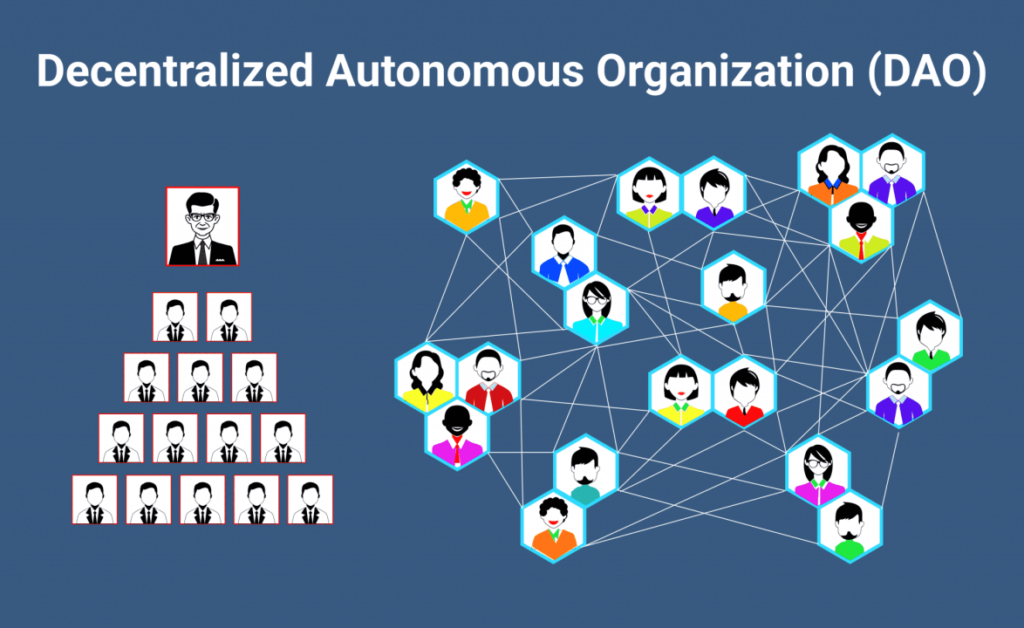
DAO Structures and On-chain Voting Processes
Maintaining Network Security and Stability Through Governance Mechanisms
- Proposals for upgrades go through community review to catch risks early.
- Voting thresholds and timelocks delay changes, giving time to spot problems.
- Emergency pauses or veto rights allow quick response to threats like exploits.
The Evolution of Governance Frameworks and their Impact on Developer Experience
- Early models were informal (off-chain discussions in forums).
- Shifted to on-chain systems for transparency and automation.
- Added tools like delegation, quadratic voting, and hybrid models to include more voices.
- Clear governance rules make upgrades predictable, so developers plan builds with less fear of sudden breaks.
- Better documentation and DAO tools reduce confusion, speed up contributions, and attract more builders.
Governance keeps blockchains adaptable while staying true to decentralization.