








The supply of digital entertainment is now, for practical purposes, infinite. AI can write, compose, film, narrate, and generate images and video and that trajectory will only accelerate. Every platform and feed is filling with content that is faster and cheaper to produce but increasingly harder to care about. For institutional investors thinking clearly about where attention and therefore durable value, concentrates in this environment, the data points in one direction – physical, irreplaceable experience. And no asset class delivers that more structurally than live sport. Fan Tokens™, and the blockchain infrastructure behind them on the Chiliz Chain, represent the first regulated mechanism for global investors to gain programmatic exposure to that thesis.
Why AI Directly Amplifies the Premium on Live Experience
Research from Thomas Gilovich and Amit Kumar at Cornell University established that people derive more lasting satisfaction from experiences than from material goods, and that the gap between the two widens as material alternatives get cheaper. As AI drives the cost of digital content toward zero, it simultaneously drives the premium on authentic, unscripted, physically present experience upward. The mechanism is self-reinforcing. More content supply means each additional unit of content delivers less marginal satisfaction, while the scarcity of live, unrepeatable events makes them worth more in relative terms.
Live sport sits at the extreme end of this spectrum. Studies document measurable physiological bonding among strangers attending the same game, heart rates align, oxytocin rises, and identity fusion occurs among people who arrived as strangers. The unpredictable outcome, the crowd, the proximity to elite athletic competition, none of these can be replicated by any model, no matter the parameters.
The Concert Precedent: What Spotify Actually Proved
The closest historical analogy is recorded music. When Spotify made music effectively free, the conventional assumption was that live concert revenue would decline as a consequence. The opposite happened. Unlimited digital access to artists stimulated demand for in-person performance by expanding and deepening audiences in ways that physical distribution never could.
The scale of that effect is now quantifiable. The top 100 global tours grossed $8.9 billion in 2025, representing a 60.8% increase from the 2019 pre-streaming baseline. Live Nation reported 159 million attendees in 2025, up 8 million year-on-year, with operating income rising 52% over the same period. Meanwhile, Bank of America Institute data shows that consumer spending on live sports is up 25% above pre-pandemic levels, outpacing even the already substantial growth in live music spend. Across both verticals, the dynamic is identical, as digital alternatives proliferate, the premium on presence intensifies. AI accelerates this pattern rather than interrupting it.
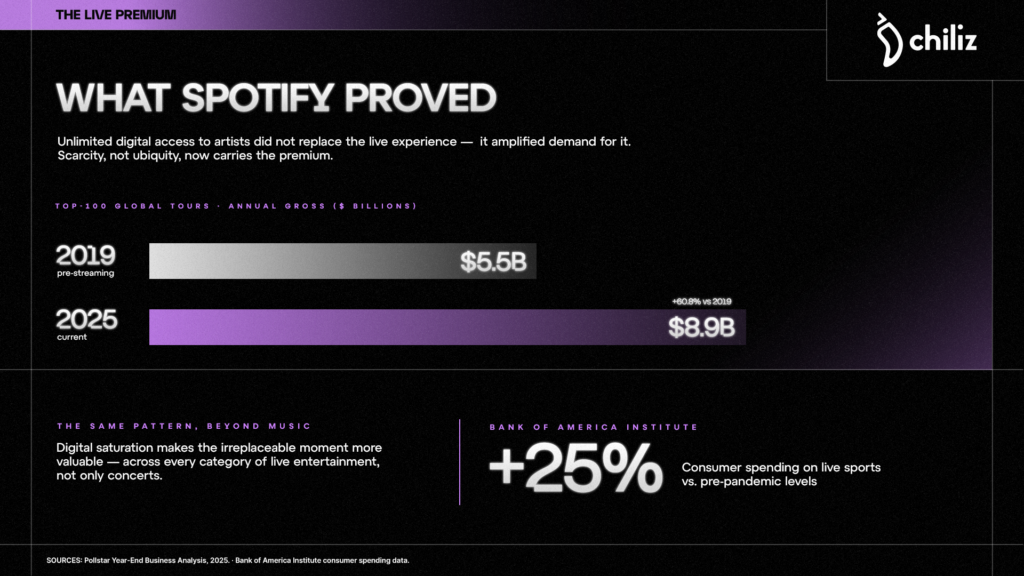
Increased digital access to music artists increased demand for live experiences.
Institutional Capital Has Already Reached This Conclusion
The most informed capital in the market has already acted on it. Ari Emanuel, CEO of TKO Group, which controls the UFC and WWE has explicitly positioned his acquisition strategy as an Anti-AI Bet, as AI reduces the cost of digital content and concentrates in live and physical assets. TKO has deployed billions in acquisitions on that basis.
In April 2026, Joshua Kushner, founder of Thrive Capital and a lead investor in both OpenAI and Stripe announced Thrive Eternal, a permanent capital holding company structured specifically to acquire sports franchises. The stated rationale was unambiguous. These are “assets with qualities that cannot be replicated by technology. Iconic franchises and cultural institutions rooted in tradition, identity, and shared experience.” The first acquisition was a minority stake in the San Francisco Giants, valued by Forbes at $4.05 billion at the time of the deal.
In August 2024, the NFL opened its ownership structure to institutional investors for the first time. Arctos, Ares, Sixth Street, Blackstone, Carlyle, CVC, and Dynasty collectively committed $12 billion to be deployed across franchises. The highest-value sports league in the world had concluded that live sport belongs in institutional portfolios and that the capital markets needed structured access to it.
Three Billion Fans, Zero Financial Stake
Institutional capital can now access sports franchises through established vehicles. What does not yet exist at any meaningful scale is a pathway for the three billion people globally who follow sport to hold any financial stake in the clubs they helped build into multi-billion dollar enterprises through decades of loyalty, spend, and cultural energy.
The latent demand for that access is measurable. Detroit City FC sold roughly 10% of the club via equity crowdfunding in 2020, raising $1.5 million from 2,708 investors at an implied $10.8 million valuation. The club is now valued at $35 million, a 3x return for those early community investors. Oakland Roots SC raised $3.6 million across 6,300+ investors through Regulation CF and Regulation A rounds; the club was subsequently valued at $93 million, up 19% from the initial round. The Green Bay Packers raised $65.8 million from 176,000 fans through share sales. In each case, the mechanism was bespoke, jurisdiction-specific, and structurally impossible to replicate at global scale.
What the market lacks is infrastructure, a regulated, programmable, interoperable layer through which sports assets can be tokenised and distributed across borders at the speed of digital finance rather than the pace of securities law. That is the gap Chiliz is built to close.
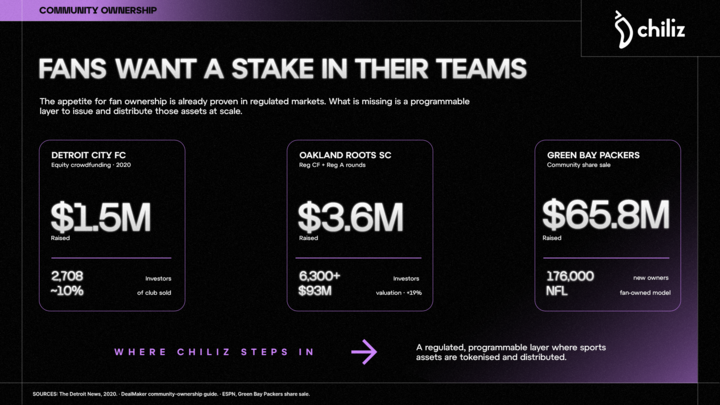
Chiliz can scale demand for fan ownership
The Chiliz 2030 Roadmap
The Chiliz 2030 roadmap structures the progression in three stages, each building on the protocol integrity of the last.
Fan Tokens™ represent the current product. Since the first Fan Token launch in 2019, the category has generated $700M+ in new income for sports organisations, reached a peak market capitalisation of $1B+, recorded $800M+ in peak daily trading volumes across 170+ exchanges, and expanded to 70+ clubs. The Omnichain Expansion, bringing Fan Tokens™ to Solana and Base via the LayerZero OFT standard, established a unified circulating supply architecture across three chains simultaneously, opening Fan Tokens™ to the full DeFi ecosystem for the first time. The $CHZ buy-back and burn mechanic, now live at the protocol level, directs 10% of all Fan Token revenue to monthly open-market $CHZ purchases, creating a direct, on-chain link between sports fandom activity and circulating supply reduction.
Revenue-sharing instruments are the second stage, targeting 2027. These products allow fans to earn directly from club performance, converting supporter loyalty into a measurable financial yield rather than a governance signal alone.
Fractional minority equity stakes are the third stage, with a 2030 target, structured fractional ownership of franchises, settled on-chain, accessible globally.
The first real-world asset instruments in the SportFi category are already live. Decentral’s RWA pool on Chiliz Chain converts football media-rights receivables into a regulated instrument generating 12% APY, demonstrating that the pipeline from physical sports asset to on-chain yield product is operational, not theoretical.
Dual Regulatory Clearance
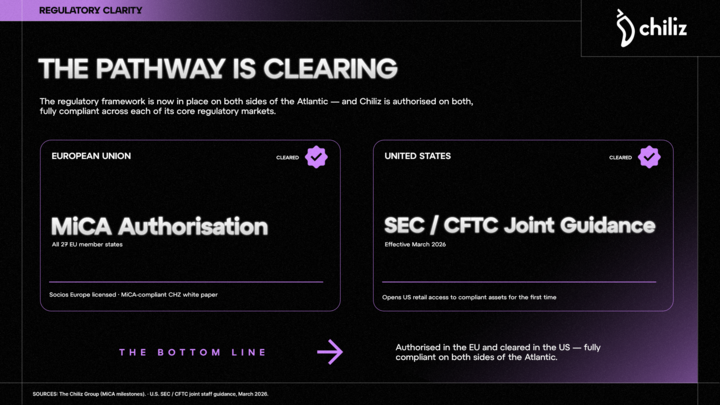
Regulatory framework is in place.
Infrastructure quality alone does not define competitive position in this market. Regulatory standing does. Chiliz holds a position no competing platform currently matches. MiCA authorisation covers all 27 EU member states, providing the highest-standard consumer protection framework available in regulated digital asset markets. The joint SEC/CFTC guidance issued in March 2026, classifying Fan Tokens™ as digital collectibles rather than securities, opens US retail access for the first time and significantly reduces the compliance burden for any institution seeking exposure to sports digital assets in the American market. No competing SportFi platform holds both clearances simultaneously.
The investment thesis for sports franchises in an AI-driven world is well established. The institutional capital is moving. The fan demand for financial participation is documented and demonstrably unmet. The regulatory framework is now in place on both sides of the Atlantic. Chiliz Chain is currently the only protocol positioned to connect all three, at global scale, through infrastructure built specifically for sports and entertainment, with the governance controls and omnichain architecture to operate across the full distribution layer that this asset class requires.